No Shit, There I Was: Frozen in Place at the End of the World
A Civil Affairs Officer's Account of JPMRC 23, Fort Wainwright, Alaska
Branch: Army
Component: Reserve (TPU)
Era: 2020s
Theater: JPMRC 23, Fort Wainwright, Alaska
Unit Type: Civil Affairs Company (Minus)
---
1. Orders
The orders hit our unit like most Reserve orders hit Reserve units: abruptly, vaguely, and with the unearned confidence of someone who had clearly never been to Alaska in February.
Thirty days. Joint Pacific Multinational Readiness Center. Fort Wainwright. The 11th Airborne Division — freshly rebranded as the Army's Arctic warriors — was hosting a division-level rotation in the interior of Alaska, and someone at CACOM had volunteered our Civil Affairs company minus to support it. In what capacity, precisely, remained a mystery that would never be satisfactorily solved.
We were a Reserve TPU — a Troop Program Unit, for the uninitiated, which means we existed in that uniquely American military space of being technically deployable, occasionally funded, and perpetually misunderstood by every active-duty unit we've ever been attached to. A Civil Affairs company at that — the kind of unit whose entire purpose is building relationships with local populations, conducting assessments, and enabling commanders to understand the human terrain. Skills that require planning, integration, and a supported mission.
We would receive none of these things.
What we would receive was frostbite weather, carbon monoxide exposure, crushed porta-potties, and the singular experience of watching the United States Army spend millions of dollars to accomplish absolutely nothing in conditions that would have killed us if we'd been slightly less lucky.
But I'm getting ahead of myself.
---
II. Welcome to Wainwright (Just Kidding, Nobody Welcomed Us)
Fort Wainwright sits outside Fairbanks, Alaska, which sits at roughly the same latitude as central Sweden. In February, the sun appears for about six hours a day, rising late and setting early with the enthusiasm of someone who also doesn't want to be in Fairbanks. Temperatures hover between negative twenty and negative forty degrees Fahrenheit, a range that the human body does not meaningfully distinguish because at a certain point cold stops being a temperature and starts being a physical force, pressing against every exposed surface of skin like the atmosphere itself resents your presence.
We arrived to no onboarding whatsoever.
No one handed us a welcome packet. No one said "here's where you sleep, here's where you eat, here's where you shower, here's the battle rhythm, here's your point of contact." The 11th Airborne Division had invited what I'd estimate were over thousands of troops from Components 1, 2, and 3 — active, Reserve, and Guard, all mixed together, as well as international participants, — and had apparently not considered the question of where any of them would sleep.
This was not an oversight by a junior staff officer. This was a structural failure at the division level. Fort Wainwright does not have the infrastructure to host the population that the 11th Airborne invites to these rotations. Not enough billeting. Not enough DFAC capacity. Not enough showers. Not enough laundry. Not enough anything. They know this, and they do it anyway, because the metrics say "X troops participated in JPMRC" and nobody asks "where did those troops sleep" or "did those troops have a mission" or "did any of those troops almost die from carbon monoxide poisoning."
But again, I'm getting ahead of myself.
---
III. The LAMS
They put us in a LAMS.
For those blessed enough to have never encountered one, a LAMS — Large Area Maintenance Shelter — is a massive tent structure designed for maintaining vehicles. It is not designed for housing human beings. It does not have climate control rated for negative forty. It does not have ventilation designed for three hundred people sleeping in it. It is, fundamentally, a garage.
Three hundred-ish troops. Open bay. Cots jammed together like a refugee camp that nobody wanted to photograph. Active, Reserve, Guard — all mixed, all confused, all slowly realizing that this was going to be a very long thirty days.
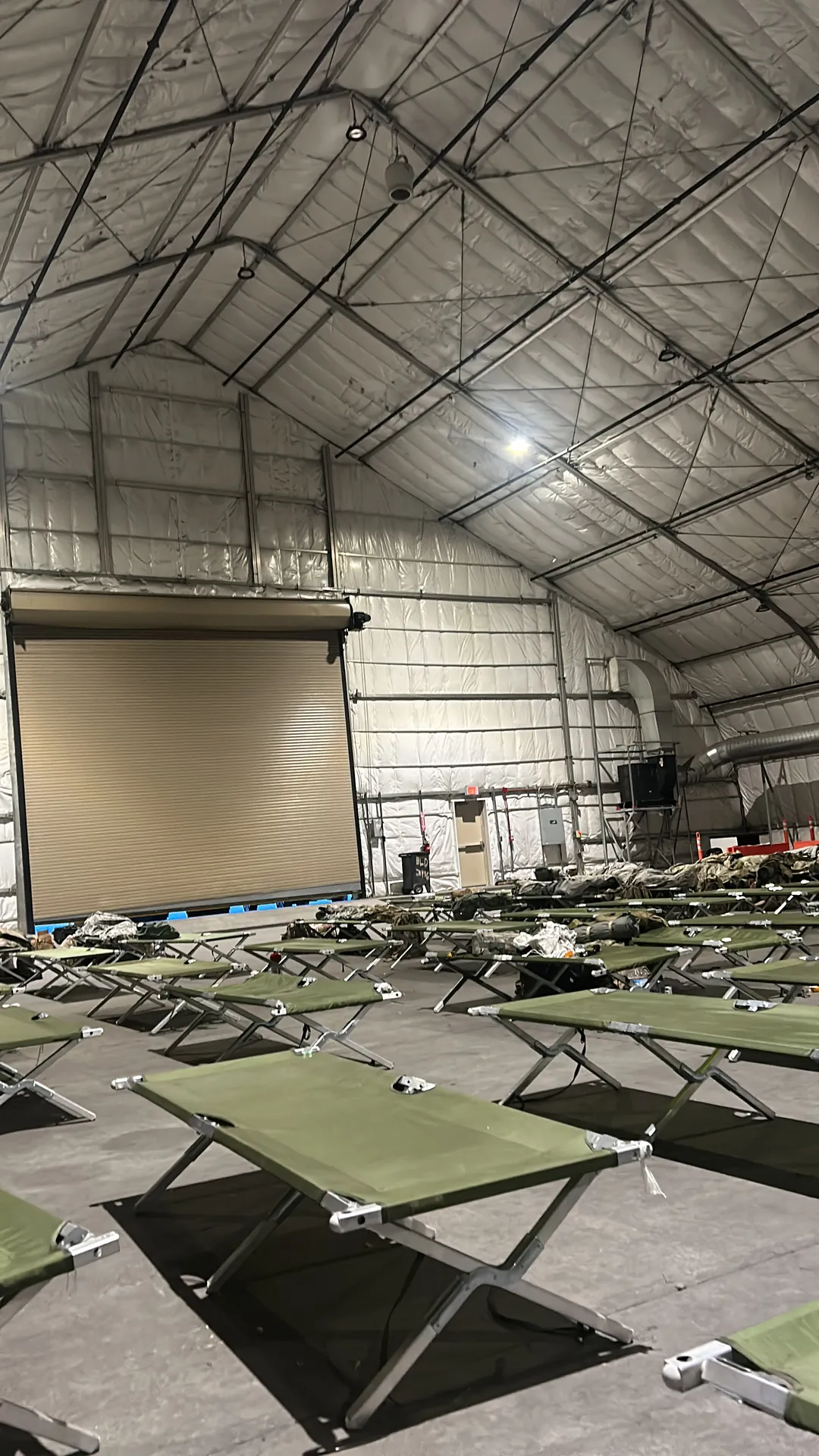
The heat didn't work for the first twenty-four to forty-eight hours.
Let me say that again with the emphasis it deserves: we were in an unheated tent in Alaska in February.
Now, the vehicles. The vehicles and other heavy equipment were parked surrounding the LAMS. Every single one of them was running twenty-four hours a day, seven days a week. They had to be. At negative forty, if you turn off a diesel engine, it may never start again. Fuel gels. Batteries die. Hydraulic fluid turns to paste. The Army's solution to this problem is to keep every vehicle running at all times, which creates a kind of permanent mechanical hum punctuated by the periodic cough of an engine that's reconsidering its participation.
It also creates exhaust.
Diesel exhaust. Seeping into the LAMS where three hundred people were sleeping.
The fire department was called multiple times to test carbon monoxide levels and air quality. Each time, they declared everything was fine. I'm not a scientist, but I am a person who was there, and I can tell you that the air inside that LAMS did not taste fine. It tasted like sleeping inside an idling truck. Which is what it was. Multiple people reported headaches. People were dizzy. The official position remained: the air quality is acceptable.
I have my doubts about the calibration of their testing equipment. I have my doubts that anyone involved in that determination was also sleeping in the LAMS. I have my doubts, and I will have them for the rest of my life, every time I get a headache for no reason.
---
IV. The Porta-Potties (A Love Story in Three Acts)
Act I: The Installation
They placed the porta-potties directly adjacent to the LAMS. In the snow. Because where else would they go.
Act II: The Physics
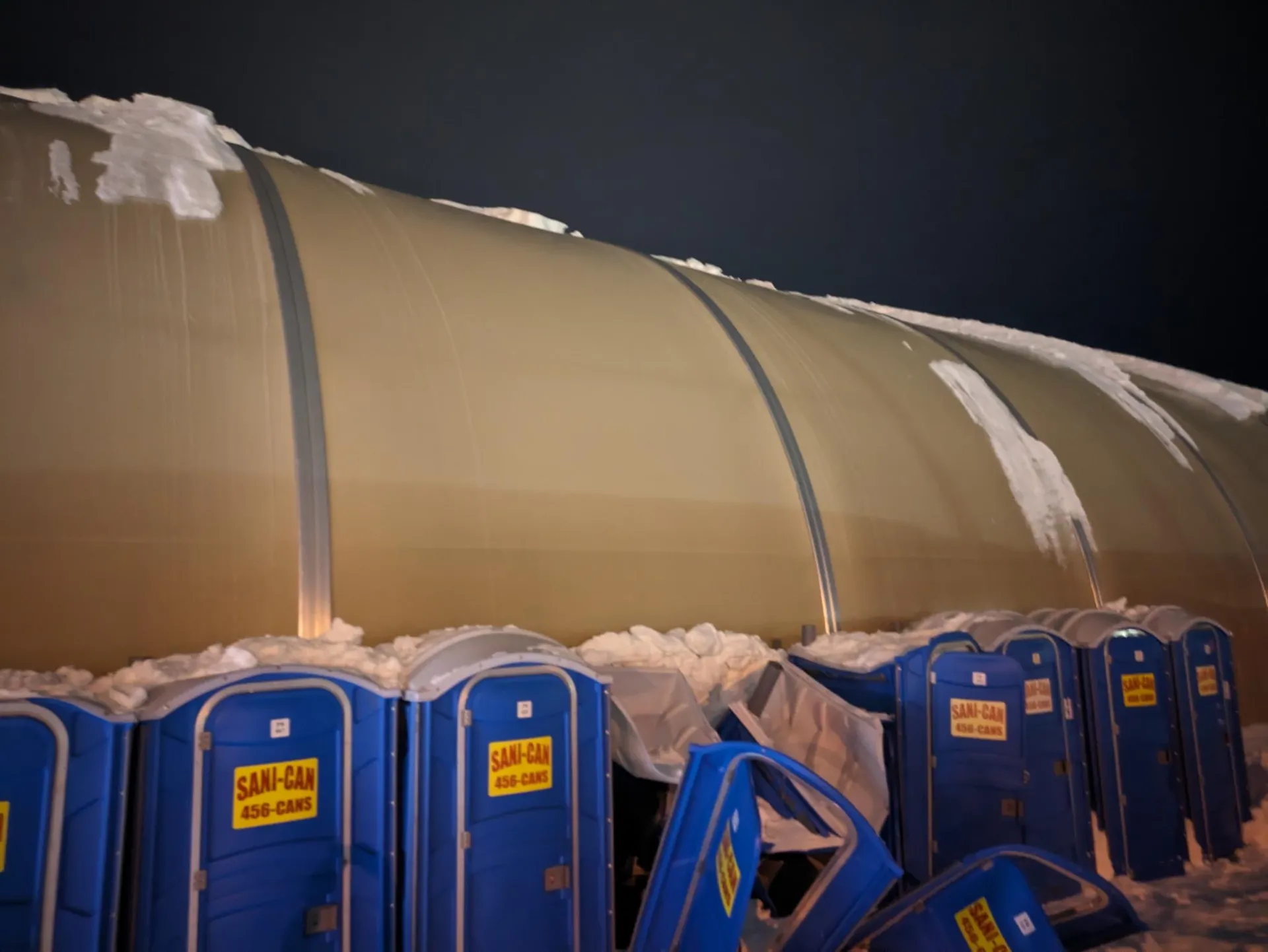
About a week in, the heat emanating from the LAMS — because the heat did eventually start working, God bless — began to melt the several feet of snow that had accumulated on the roof of the structure. This snow, having been previously content to sit frozen on top of the tent, now transformed into a slow-moving mass of ice and slush that eventually reached a tipping point and slid off the roof.
Directly onto the porta-potties.
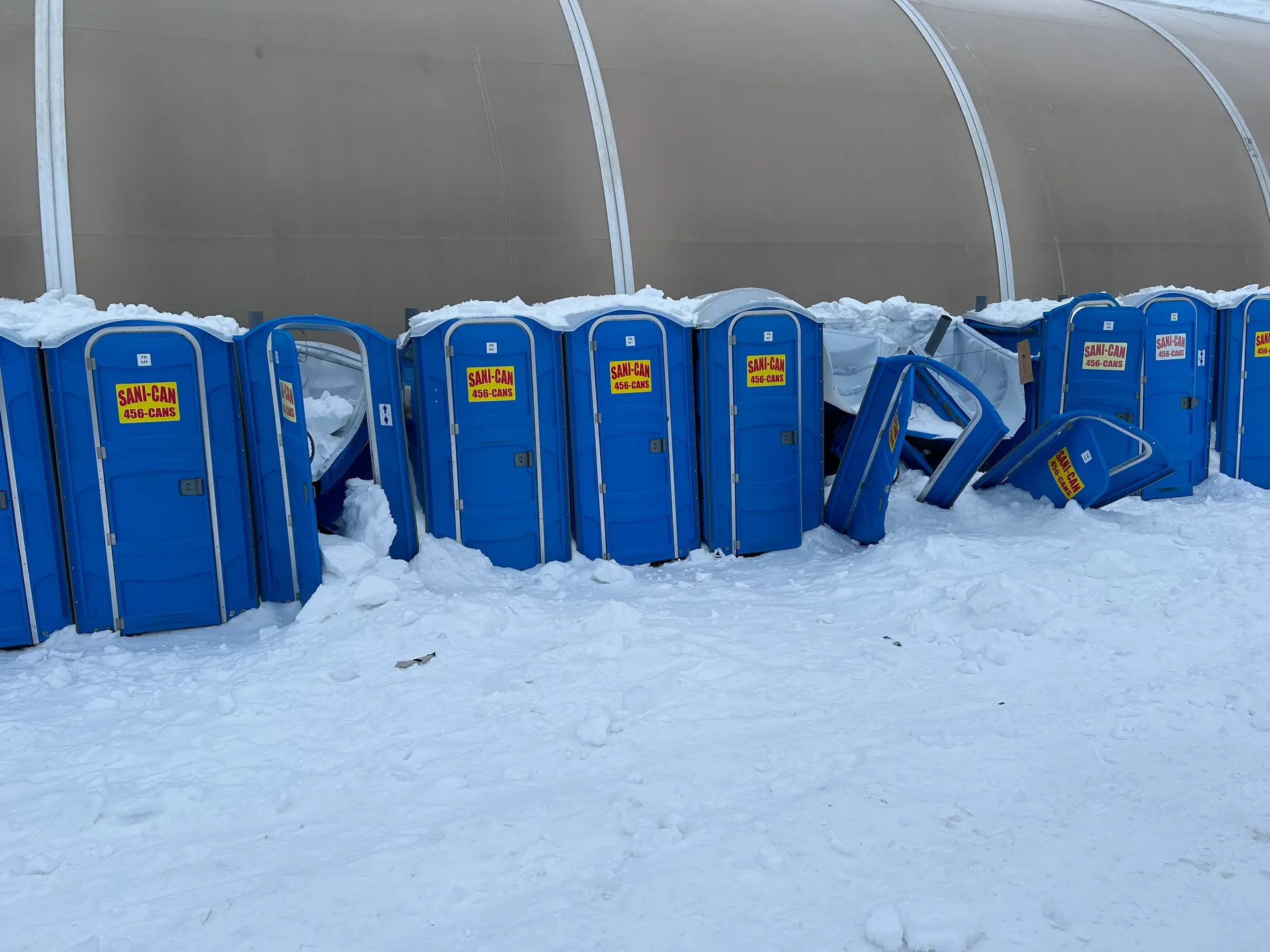
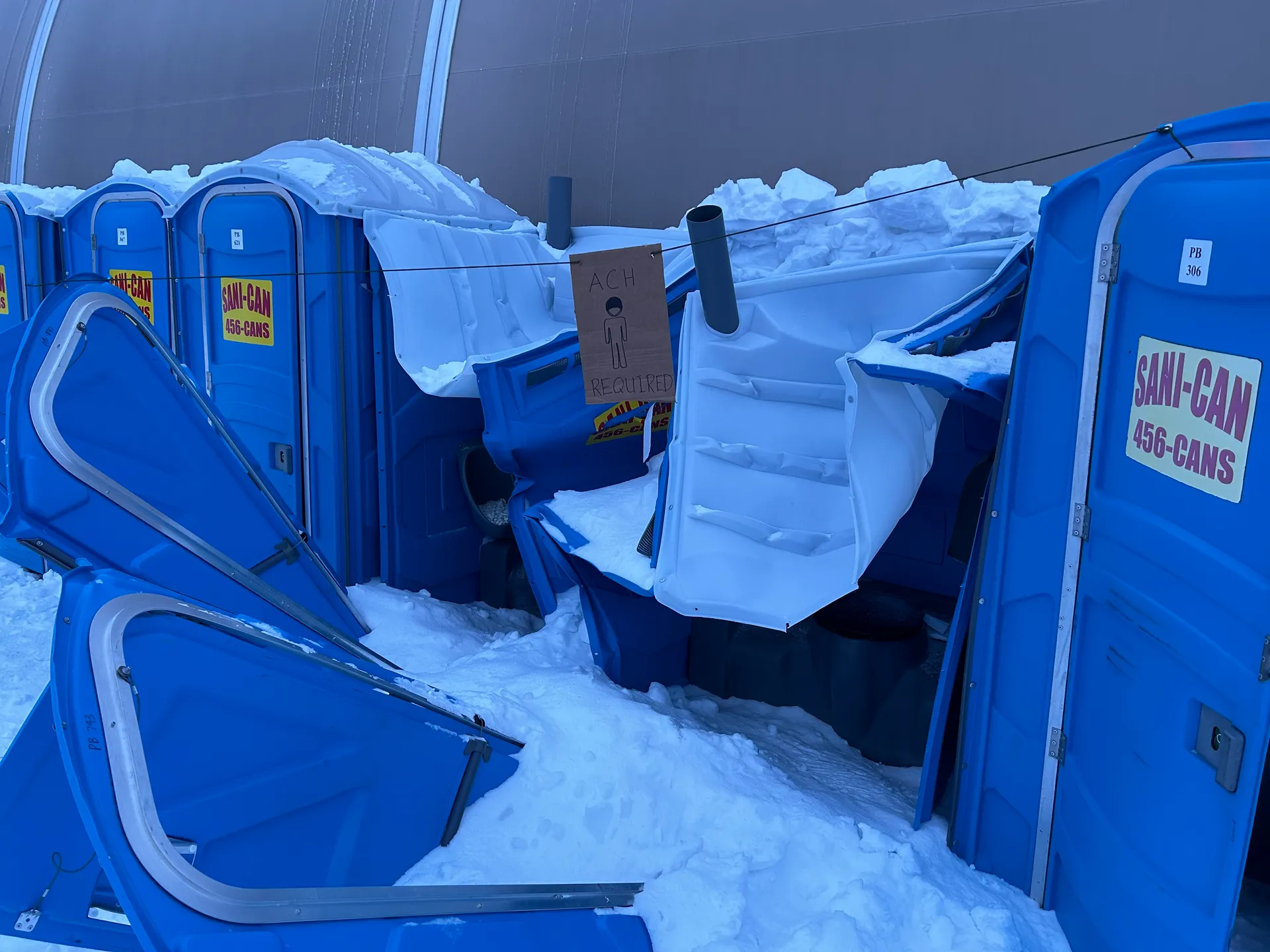
If you have never witnessed a row of porta-potties destroyed by an avalanche of ice and snow sliding off the roof of a LAMS tent in the Alaskan interior, I'm not sure I can adequately convey the image. The plastic structures didn't stand a chance. They were crushed, tipped, caved in. The contents — well. You can imagine the contents.
Act III: The Response Time
I reported the safety issue to the garrison operations team — GS-14/15 type I happened to know. This wasn't some anonymous complaint dropped into a suggestion box. This was a company-grade officer with a direct relationship to garrison leadership saying: "Sir, the toilets were destroyed by falling ice, the remaining ones are directly in the impact zone, and someone is going to be inside one of these things when the next batch of snow comes off the roof."
It took six days for the porta-potties to be moved.
Six days.
For six days, every soldier who needed to use the latrine in the middle of the Alaskan night had to walk out into negative-forty-degree darkness, navigate to a porta-potty that was visibly situated in a kill zone of potential ice and snow missiles, and hope — genuinely hope — that this would not be the particular moment when physics reasserted itself.
I want the reader to sit with that for a moment. Not as an abstraction. Imagine you're an E-3, nineteen years old. It's two in the morning. It's negative thirty-eight degrees. You need to take a shit. You walk in the dark to a porta-potty that you know — that everyone knows — is positioned under hundreds of pounds of ice and snow that could release at any moment. And you sit there.
Six days.
---
V. Showers, Laundry, and the Art of the Drug Deal
There was no structured plan for showering.
Let me be clear: it's not that the shower plan was bad. There was no plan. Three hundred troops were on ground at Wainwright and no one had worked the problem of how those troops would maintain basic hygiene over a thirty-day rotation.
What emerged instead was the military's oldest informal institution: the drug deal. Someone knew someone who knew someone in a barracks building on the other side of post. Word got passed. A door was left propped open. At certain hours, if you knew the route and didn't get caught, you could sneak into an actual barracks building and use an actual shower with actual hot water.
This was not sanctioned. This was not a plan. This was soldiers being soldiers — solving problems that their leadership either couldn't or wouldn't solve for them.
Laundry was the same story. Zero options. Zero infrastructure. Zero plan. For thirty days. In conditions where your base layer soaks through with sweat the moment you do anything physical and then freezes the moment you stop. The drug deal network eventually identified a few washing machines in various buildings around post, but access required knowing the right people, going at the right times, and being comfortable with the knowledge that you were technically trespassing.
The fundamental issue wasn't that these problems are hard to solve. They're not. The military has been deploying troops to cold weather environments for decades. Shower tents exist. Laundry services exist. Field sanitation plans exist. The issue was that no one at the division level had bothered to plan for the human beings they'd invited. The JPMRC metric was "did troops show up." Not "were troops sustained."
---
VI. The Mission (There Was No Mission)
This is where the story transitions from dark comedy to something genuinely infuriating.
We are a Civil Affairs company. Civil Affairs exists to engage with civilian populations, assess needs, coordinate civil-military operations, and enable the commander's objectives in the human domain. It is a highly specialized capability that requires integration into the operational plan. The brigade, the staff, the supported commander — everyone needs to know what CA brings to the fight and how to employ it.
Day one, the brigade we were assigned to informed our commander — and I'm paraphrasing only slightly — "Thanks for coming. Go sit under the BEB and don't cause us problems."
The Brigade Engineer Battalion. The BEB commander, to his limited credit, was honest with us: he had absolutely no idea what to do with a Civil Affairs company. He didn't ask for us. He didn't know we were coming. He had no mission for us and no framework for integrating us. We were a gift he hadn't ordered, didn't want, and couldn't return.
So we sat.
About a week in, a couple of Observer-Controller/Trainers showed up from JRTC at Fort Johnson. OCTs are the evaluators who grade these rotations. These two had been sent from Louisiana to Alaska to observe our participation in the exercise.
They were not happy.
The look on their faces when they arrived — two people who had clearly drawn the short straw back at JRTC and been told "fly to Alaska in February and go evaluate the CA company" — was one of the purest expressions of military suffering I have ever witnessed. They took one look at the situation, assessed the zero-mission reality, examined our vehicles (which had been deadlined since arrival — the negative-forty-degree cold had killed them), and made their recommendation to the 11th Airborne Division:
The CA company cannot participate for safety reasons.
Read between the lines: they did not want to go to the field.
I don't blame them. Nobody wanted to go to the field. The field was negative forty degrees and we had no mission. But the official language was "safety," and officially that was true — our vehicles were deadlined and sending soldiers into the Alaskan wilderness in February without functional transportation is, in fact, a safety issue.
The division overruled them.
Let me say that again: the Observer-Controller/Trainers — the people whose literal job it is to ensure safe and effective training at combat training centers — recommended that we not participate. And the 11th Airborne Division said no, you're going. Because the division needed bodies in the field for their numbers. Because the metric isn't "did units train effectively" but "did units participate." Because somewhere in a briefing slide there was a box that needed a checkmark, and our presence in the frozen wilderness was that checkmark.
So the OCTs were stuck with us. And we were stuck with the OCTs. And everyone was stuck in Alaska.
By the end of the first week, our team — through a heroic effort that deserves its own story — managed to claw most of our vehicles back from the dead. Batteries replaced, fluids changed, engines coaxed back to life through the kind of stubborn mechanical intimacy that only soldiers who've been screamed at about deadlines can achieve. The vehicles were operational. We could move.
We just had nowhere to go and nothing to do when we got there.
---
VI½. "Why Didn't You Just Train Yourselves?" (A Preemptive Defense)
I can hear the reader — probably a retired sergeant major, — asking the question: "So you had vehicles, you had soldiers, you had time. Why didn't you self-organize training? What kind of lazy officer just sits around for three weeks?"
Fair question. It deserves an honest answer instead of excuses, so here's the honest answer:
Civil Affairs engagement training without role players is like practicing couples therapy by yourself. The entire skill set is interpersonal. It's reading a room, building rapport, negotiating with a village elder who has his own agenda, assessing needs through conversation, navigating cultural dynamics in real time. You can rehearse your approach. You can drill your assessment framework. You can practice your questions in a mirror. But without a trained, culturally briefed human being on the other end giving realistic responses — pushing back, lying to you, testing you — you're performing a monologue and calling it a dialogue. The whole point of going to a CTC rotation was to get that external, evaluated training environment. We didn't travel to Alaska to practice talking to each other. We can do that at home station for free.
We were under a BEB commander's authority, not freelancing. You don't self-organize training in someone else's battlespace during a division-level exercise. The BEB owned us. Their commander had been told we existed and told to keep us out of trouble. If we'd gone rogue — "hey sir, we're going to go run our own engagement lanes in your AO, hope you don't mind" — we're now an uncoordinated element in an active exercise. That creates radio traffic confusion, potential safety incidents, and a BEB commander who rightfully asks why the CA company he didn't want is now freelancing in his battle space without coordination. The military does not work the way civilians imagine. You don't just "go find something productive to do" when you're attached to a unit that has told you, in clear terms, to sit still and not cause problems.
The OCTs had been overruled, not convinced. When the people grading your training tell the division "this unit shouldn't participate" and the division says "they're going anyway," that creates a dynamic where the OCTs are now babysitting a unit they tried to pull from the exercise. They're not going to help you build creative training solutions. They're going to sit with you, document the waste, and count the days until they can fly back to Louisiana.
Did we do some internal training? Yes. We ran through our own SOPs. We rehearsed formats. We held classes where we could. We did the things a competent unit does when it has time to fill. But I'm not going to pretend that running battle drills in a LAMS between cots, or practicing our assessment methodology on each other for the eighth time, was a meaningful use of a thirty-day combat training center rotation. It wasn't. And claiming otherwise would be exactly the kind of dishonesty this platform exists to call out.
The failure here isn't that a company of soldiers didn't invent training out of thin air. The failure is that a division invited a CA company to a rotation without building a single engagement lane, assigned us to a BEB that didn't know we were coming, overruled the evaluators who said we shouldn't participate, and then sent us to the field to check a box. We didn't fail to self-organize. The organization failed to give us anything to organize around.
---
VII. The Culture Mayors
The division's solution to "we have a CA company with no mission" was to hastily scrape together a few PV2s and SPCs — privates and specialists, the most junior soldiers available — and designate them as "culture mayors." These were supposed to be the role-players for our Civil Affairs engagement lanes. They were supposed to act as village elders, local leaders, community representatives — the human terrain that CA is designed to work with.
They received no training. They were given scripts. Not good scripts. Hastily assembled scripts that read like someone had Googled "what do village elders do" at two in the morning and printed whatever came up. These junior soldiers — who were themselves there to train, not to teach — were thrown into the deep end of a pool that didn't have water in it.
The entire engagement program was a waste. A complete, comprehensive, top-to-bottom waste of everyone's time, taxpayer money, and whatever shred of training value this rotation was supposed to provide. We conducted one single thirty-minute engagement for a company of roughly twenty-five soldiers. One. In thirty days. The rest of the time was sitting. In the field. In negative-forty-degree weather. Doing nothing.
---
VIII. The Generals
About two week and a half in, leadership descended.
The battalion commander — a lieutenant colonel — and the brigadier general from CACOM flew to Alaska for two to three days. They were there, ostensibly, to talk to the division about Civil Affairs integration and to check on their soldiers.
They came to the field. They met the company.
For fifteen minutes.
Fifteen minutes. After flying thousands of miles to visit soldiers who had been sleeping in diesel fumes, shitting in crushed porta-potties, and executing zero meaningful training for over a week. Fifteen minutes.
They gave a speech. I'll spare you the details because you already know the speech. It was the speech. The "great training" speech. The "building readiness" speech. The "proud of what you're accomplishing" speech. It was delivered to soldiers who were accomplishing nothing, by leaders who had to know — who had to know — that the situation on the ground bore no resemblance to the words coming out of their mouths.
They joined briefly for one of the "mayor engagement" lanes. They did not talk to the troops. Not in any real way. Not "how's the food situation" or "are you getting showers" or "what do you need." Not the questions that leaders ask when they actually want to know the answer.
No coins. No meaningful recognition. No pulling the company commander aside and saying "talk to me — what's really happening out here." Just the speech, a few handshakes, and they were gone. Back to heated buildings. Back to functioning plumbing. Back to wherever generals go when they're done pretending.
The troops noticed. Troops always notice.
---
IX. The Field
We went to the field anyway. Because the Army always goes to the field.
We went without fully functional Arctic shelters. These were supposed to provide survivable sleeping conditions in extreme cold. Ours were not fully operational. We had received approximately four hours of classroom cold-weather training and roughly two hours of hands-on tent setup in garrison conditions, which is to say, conditions that bore no resemblance to actual field conditions in the actual Arctic in actual negative-forty-degree weather.
We slept in the vehicles.
Let that settle. We were in the field, in interior Alaska, in February, sleeping in JLTVs because we didn't have functioning Arctic shelters. The vehicles were running — they had to be running or they'd die — so we were, once again, sleeping in diesel exhaust. But now we were in the field, where there was no fire department to come test the air quality and tell us it was fine.
We were out there for six or seven days. Six or seven days of sitting in vehicles, running engines, burning fuel, and accomplishing nothing. The one engagement — the thirty-minute exercise with the hastily-scripted culture mayors — was the sum total of our training output. The ratio of resources expended to training value received was, and I do not say this hyperbolically, approaching infinity.
---
X. A Note on the 11th Airborne Division's Theory of Arctic Warfare (Or: Why Are We Doing This?)
I want to step back from the narrative for a moment and address something that everyone there was thinking but no one with rank was willing to say out loud:
Why the fuck are we operating heavy armored vehicles in the negative-forty-degree Arctic?
This is not a question born of ignorance. This is a question born of watching the United States Army drive heavy vehicles through conditions that those vehicles were never designed to operate in, watching them break constantly, watching them consume fuel at extraordinary rates just to stay alive, and watching the maintenance tail grow so long that the vehicles spent more time being fixed than being used.
The 11th Airborne Division was reactivated in 2022 with the explicit mission of being the Army's Arctic and extreme cold-weather fighting force. This is a reasonable mission. The Arctic is increasingly a contested domain. Russia operates in it. China has declared itself a "near-Arctic state." The Northern Sea Route is opening. There are legitimate strategic reasons for the United States to have an Arctic-capable ground force.
But the 11th Airborne appears to be building that force by taking a conventional mechanized warfare model and simply doing it in the cold. Same equipment. Same operational concepts. Same force structure. Just colder. And that is, to anyone who has spent five minutes thinking about it, an extraordinarily stupid way to fight in the Arctic.
Here is what happens when you operate heavy equipment at negative forty:
Everything breaks. Hydraulic lines crack. Batteries die. Fuel gels if it's not treated. Rubber seals become brittle and shatter. Track tension changes. Electronics malfunction. The maintenance requirement for every piece of heavy equipment roughly doubles in extreme cold, which means you need twice the maintainers, twice the parts, twice the time, and twice the money to keep the same number of vehicles operational. And you will still have more deadlined vehicles than you would at room temperature.
Fuel consumption is obscene. Every vehicle runs twenty-four/seven because if it stops running, it becomes a very expensive lawn ornament. The fuel required to sustain a brigade in the Arctic — not fighting, just existing — is staggering. The logistics tail to supply that fuel in a contested Arctic environment, with limited road networks and seasonal port access, is a problem that no one at the JPMRC seemed particularly interested in solving.
The enemy gets a vote. And the enemy's vote, in the Arctic, favors the light and the fast. Drones. Small units on skis or snowmobiles. Aircraft. Long-range precision fires. The force that wins in the Arctic is the force that can move quickly, sustain itself with minimal logistics, and operate in conditions where heavy equipment is a liability.
What the 11th Airborne is doing instead is dragging a conventional mechanized force into the coldest conditions on the North American continent, watching everything break, and then calling it "training." It is training in the same way that driving your car into a lake is training for underwater operations. You will certainly learn something. But the lesson should be "don't do this," not "let's do this more."
The troops on the ground know this. Every maintainer who spent sixteen hours on a deadline that wouldn't exist at Fort Polk knows this. Every driver who nursed a heavy vehicle through a movement that a snowmobile could have made in a quarter of the time knows this. Every logistician who looked at the fuel consumption numbers and did the math on what a contested resupply would look like knows this.
But the 11th Airborne Division needs to justify its existence as a division, which means it needs to operate division-level equipment, which means heavy equipment in the snow, which means JPMRC looks exactly like an NTC rotation but colder and more expensive and less effective.
If the Army is serious about Arctic warfare — and it should be — it needs to build a force from the ground up around the requirements of the environment, not shove its existing force into the environment and hope for the best. That means lightweight, highly mobile units. It means heavy investment in drones, both for surveillance and strike. It means ski-mobile infantry. It means pre-positioned supply caches rather than long-haul logistics convoys. It means an entirely different model of warfare than the one the Army has been practicing since Desert Storm.
Instead, we got heavy equipment running twenty-four/seven in a maintenance tent full of diesel fumes while hundreds of soldiers waited for a mission that never came.
---
XI. The Receipt
Here is what the United States Army spent on our participation in JPMRC 23:
- Thirty days of salary and per diem for a reserve CA company minus
- Round-trip transportation from CONUS to Wainwright
- Vehicle shipping costs for equipment that was deadlined upon arrival
- Two OCTs flown from Fort Johnson, Louisiana to Alaska to evaluate a unit that did nothing
- A lieutenant colonel and a brigadier general flown to Alaska for fifteen minutes of rah-rah
- Thousands of gallons of fuel to keep vehicles running that never left the motor pool (and then the field, to do nothing)
- Untold maintenance costs for cold-weather damage to vehicles
- Whatever it cost to call the fire department multiple times to tell us the air was fine
- Six days of someone eventually moving porta-potties
In exchange, the Army received:
- One thirty-minute Civil Affairs engagement exercise
- A story I'm telling you right now
---
XII. What Should Have Happened
This section is not sarcasm. This is what a competent organization would have done.
Before the rotation: Coordinate with Fort Wainwright garrison to confirm billeting, DFAC, shower, and laundry capacity for the invited population. If capacity doesn't exist — and it didn't — either reduce the invited force or build the infrastructure before troops arrive. This is not a hard problem. The Army solves harder problems every day.
For the CA company: Either integrate us into the operational plan with a real mission — Civil Affairs engagement lanes with trained role players, realistic scenarios, and evaluation criteria — or don't invite us. We would have gotten more training value from a two-week home station exercise than from thirty days of sitting in the cold.
For the field rotation: If the Arctic shelters aren't functional, don't go to the field. Full stop. Sending soldiers into negative-forty-degree conditions without adequate shelter is not training. It's negligence dressed up as toughness.
For the porta-potties: Move them the same day they're identified as a safety hazard. Not six days later. The same day. This is not a resourcing problem. It's a leadership problem.
For the leadership visit: If a general officer flies to Alaska to see troops, that general officer should spend the day — not fifteen minutes — and should ask the questions that matter. Not "how's the training going" but "are you being fed, are you being sheltered, do you have a mission, what do you need." And then fix what needs fixing. That's what generals are for.
For Arctic doctrine: Go study the Finns. Go study the Norwegians. Go talk to the Canadian Armed Forces, who train in the Arctic every winter and have figured out how to do it without killing vehicles and wasting millions. Stop trying to be a equipment laden division in the snow and start being the light, fast, lethal force that the Arctic actually requires.
---
XIII. Why I'm Writing This
I'm not writing this to get anyone in trouble. The individual soldiers, NCOs, and junior officers at JPMRC did what soldiers always do: they adapted, they survived, they helped each other, and they found ways to laugh about it. The drug-deal shower network was, in its own miserable way, a beautiful example of small-unit initiative.
I'm writing this because the system that sent three hundred soldiers to Alaska without a shower plan, housed them in a maintenance tent full of diesel fumes, destroyed their toilets and took six days to fix them, assigned them no mission, evaluated them on training they didn't receive, and then declared it a success — that system needs to be seen clearly.
The 11th Airborne Division's Instagram account posted beautiful photos from JPMRC 23. Soldiers in the snow. Arctic warriors forging ahead. It looked amazing.
It was not amazing.
It was a story about an organization that values the appearance of readiness over the reality of it. That counts bodies in seats over training received. That would rather check a box than solve a problem. And that will, if nothing changes, get people hurt — or worse — in a real Arctic fight because the muscle memory they're building isn't "how to fight in the cold." It's "how to sit in the cold."
I was there. This is what happened.
If this story resonated with you and you need to talk to someone, help is available 24/7.